


In Park City, Alpine Distilling has never been content to simply produce spirits. From the beginning, the distillery has operated in a space of its own—where botanical science, culinary collaboration, distilling craft and sensory experience converge. It’s a philosophy that has shaped everything from its award-winning spirits to its immersive hospitality offerings.
Now, that same perspective is extending beyond the glass. With the launch of Forager, a new mobile app, Alpine Distilling is introducing a different way to understand flavor—one rooted not in theory, but in experience.
Beyond the Bottle
At its core, Forager is a guide to the hidden world of botanicals—the roots, flowers, barks and seeds that define every great spirit.
But it doesn’t present that knowledge in a traditional format. Instead, the app is designed as an interactive journey, inviting users to explore botanicals across six continents, learning where they grow, how they’re harvested and why they matter — not just conceptually, but sensorially. Each day brings a new discovery. Each interaction builds familiarity. Over time, what begins as curiosity evolves into something more intuitive: a deeper understanding of what you’re actually tasting.
Led by a Distiller’s Perspective
The vision behind Forager is shaped by Sara Sergent, who pushes the boundaries of what a distiller can be. A James Beard Award semifinalist — and the first gin distiller ever nominated in the beverage service category — Sergent has built her career not just on creating spirits, but on integrating them into a broader culinary conversation. Her work spans collaborations with chefs, national culinary programming and international botanical study, all grounded in a belief that flavor is something to be explored, not simply consumed.

Forager is a natural extension of that philosophy. Rather than positioning spirits as a finished product, it opens the door to the ingredients themselves, inviting users to understand flavor at its source.
Learning Through Experience
What sets Forager apart is its approach to learning. The platform is built around interaction: daily botanical discoveries, a growing “botanical passport,” and a progression system that moves users from Seedling to Master Forager. Along the way, users unlock ingredients, earn experience points and engage with a series of challenges designed to reinforce knowledge through repetition and play.
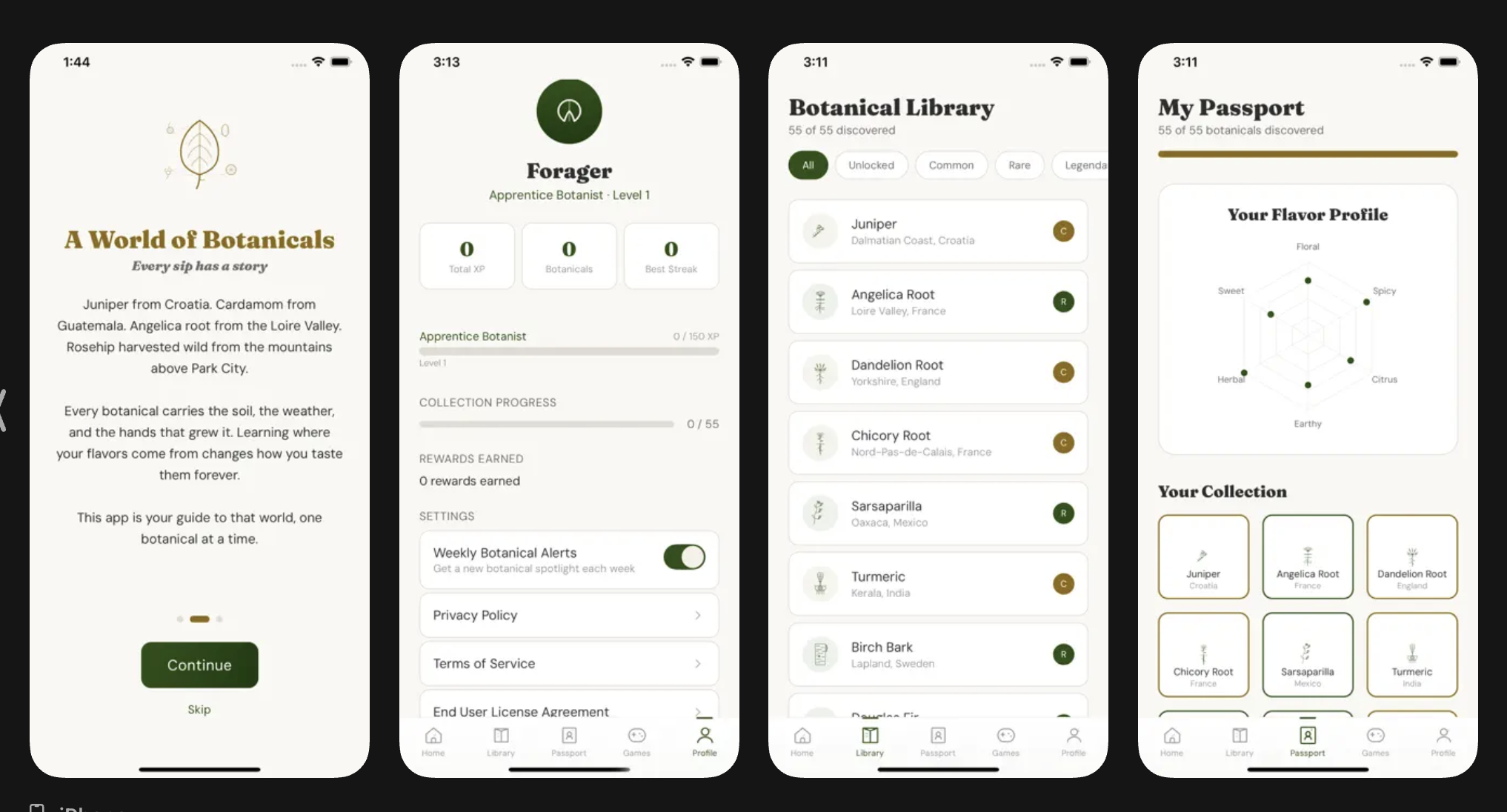
There’s also a practical layer — one that brings the experience back into the glass. A curated cocktail catalog allows users to see how botanicals come together in real-world applications, connecting discovery with use. The result is something that feels less like an app and more like an evolving relationship with flavor.
A Category of Its Own
With Forager, Alpine Distilling isn’t simply launching a digital product—it’s expanding what a distillery can be. In an industry that has traditionally centered on production and distribution, this marks a shift toward something more immersive: a consumer-facing ecosystem built around education, engagement, and sensory memory. It also positions Alpine Distilling in a category of its own. As the only distillery currently operating at the intersection of botanical science, culinary application and now technology, the brand continues to redefine how people connect with what they drink.

From Park City to a Global Perspective
While Alpine Distilling is firmly rooted in Park City, Forager reflects a much broader worldview. The app draws on a global network of botanicals and influences shaped by Sergent’s work across continents — from botanical gardens in Kyoto and London to advanced study in Scotland and collaboration within the international culinary community. That perspective is distilled — quite literally — into an experience that is both accessible and expansive, inviting users to explore flavor as something dynamic, layered and deeply connected to place.
A New Kind of Connection
For those who have followed Alpine Distilling, Forager feels like a natural next step. For those encountering the brand for the first time, it offers an entry point that is both approachable and unexpectedly rich. Either way, it signals something larger: a shift in how we engage with what we taste, and a reminder that behind every great spirit is a story waiting to be understood.